










Every motorcycle and scooter rental shop owner knows the moment: a customer returns from a full day of riding, hands back a helmet that is damp with sweat, and your staff quietly dreads what comes next. In our 10+ years manufacturing intelligent hygiene equipment, we have spoken with hundreds of rental operators across Southeast Asia and South America, and the story is always the same—manually wiping helmets between rentals is slow, inconsistent, and terrible for business reviews. Choosing the right Motorcycle Helmet Washer solves this permanently, but only if you know what to look for. Cheap machines flood the market, and a wrong purchase can leave you with broken equipment, unhappy customers, and zero return on investment. This guide distills everything we have learned from real deployments so you can evaluate any Helmet Cleaning Machine like an industry insider and buy with total confidence.
Why Motorcycle Rental Shops Need a Dedicated Helmet Washer
Shared helmets sit directly against a rider’s skin, absorbing sweat, hair oils, sunscreen, and road dust. In a humid climate, a single heavily used liner can host millions of bacteria within hours. For a rental shop, that translates into three concrete business problems.
First, customer satisfaction collapses the moment a rider pulls on a damp, smelly helmet. One negative review mentioning helmet hygiene can suppress bookings for weeks. Second, manual cleaning consumes paid labor. Wiping, spraying, and air-drying 30 to 80 helmets a day can easily consume two or more staff-hours—every single day. Third, inconsistent cleaning is a liability. A rushed wipe with a generic disinfectant spray does not penetrate the foam liner where bacteria actually live, and health regulators in an increasing number of tourist regions are tightening hygiene requirements for shared wearable gear.
A dedicated helmet washer eliminates all three problems at once: it sanitizes deeply and consistently, it frees your staff for revenue-generating work, and it signals to every customer that you run a professional operation.
The 7 Factors That Define the Best Motorcycle Helmet Washer
Before comparing brands or prices, evaluate any machine against these seven criteria. They are ranked in the order that matters most for high-traffic rental operations.

1. Cleaning Technology: Dry Cleaning Protects Your Helmet Inventory
The single most important decision is the cleaning method. Many first-time buyers assume a water-based wash is “deeper,” but liquid washing is actually the riskiest option for rental fleets. A helmet’s protective core is an Expanded Polystyrene (EPS liner) that absorbs impact energy in a crash. Soaking or steam-cleaning that liner accelerates EPS liner degradation, warps the inner shell, and leaves damp residue that breeds mold inside the padding.
The superior approach—proven across thousands of commercial deployments—is Comprehensive Dry Cleaning using UV + Ozone Ultraviolet Radiation. Controlled-temperature ozone gas penetrates every microscopic pore of the liner and neutralizes sweat enzymes, destroying 99.9% of bacteria, viruses, and fungi at the cellular level. UV radiation adds a surface-level disinfection pass. Because the process uses no liquid chemicals, helmets come out warm, dry, fresh-smelling, and structurally untouched. Always ask a supplier to explain exactly how their machine treats the EPS liner—if the answer involves water jets or soaking, walk away.
2. Throughput and Chamber Design
Rental shops live and die by peak-hour throughput. A single-chamber machine forces the second customer to wait, and queues kill the perceived convenience that makes a paid cleaning service attractive.
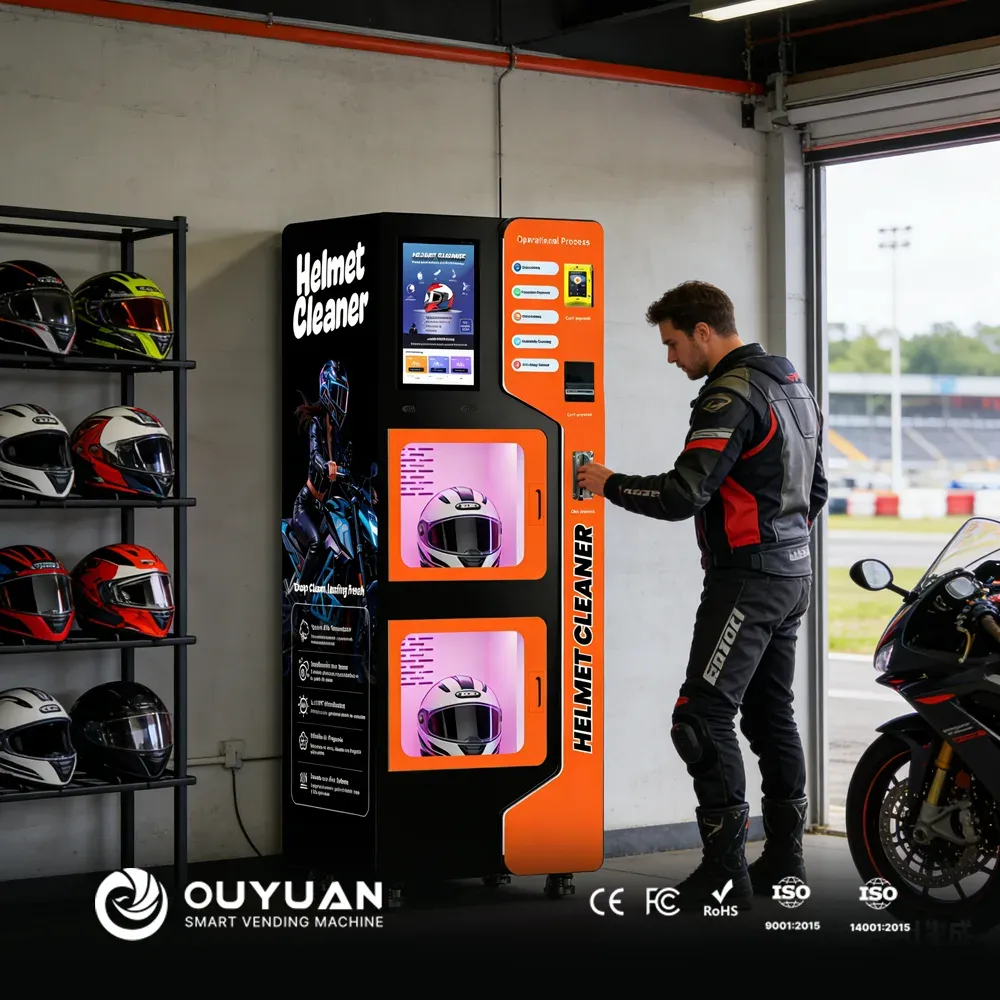
A Dual Chamber (A/B) Design is the sweet spot for most rental shops: two helmets process simultaneously and independently, so a 12-minute deep cycle on a heavily soiled full-face helmet never blocks a 7-minute quick cycle on an open-face helmet next to it. When evaluating capacity, ask about independent operation specifically—some budget machines share one airflow system between chambers, halving real-world throughput.
3. Cycle Time Flexibility
Different helmets need different treatment. The best machines ship with preset cycles plus programmable custom modes:
- Normal cleaning: a rapid 7-minute cycle for lightly used helmets, maximizing daily turnover.
- Advanced cleaning: a thorough 12-minute cycle for heavily soiled or rain-dampened helmets.
- Custom mode: facility managers program exact durations to match local humidity, usage intensity, and peak-hour schedules.
Avoid machines with a single fixed cycle—your Monday-morning rush and your rainy-season Saturdays have nothing in common.
4. Payment Methods Matched to Your Market
A Motorcycle Helmet Washer in a tourist rental district must accept however your customers actually pay. In most Southeast Asian markets, QR code scanning (local e-wallets) captures the majority of transactions. Latin American and European locations often demand bill acceptors and coin slots, while tap-to-pay NFC Bank Card readers are spreading everywhere. Confirm the machine supports your target combination—and verify that currency configuration is handled at the factory, not by a third-party reseller you will never meet again.
5. Durability, Stability, and Footprint
Rental shops are tough environments: humid air, sandy floors, and hundreds of daily user interactions. A commercial unit should weigh around 115 kg with an industrial-grade steel chassis—that mass is not a shipping inconvenience, it is vandal resistance and operational stability in a semi-public space. Check the dimensions against your floor plan: a compact 650(W) × 1790(H) × 550(D) mm footprint fits comfortably beside a gear-return counter without consuming premium retail area.
6. Daily Maintenance Requirements
Your staff’s time is the hidden operating cost most buyers forget to price in. Dry-process machines need no water tanks, no hoses, no drainage, and no detergent restocking—routine maintenance is essentially wiping the chamber and emptying a payment cassette. Before signing any purchase order, ask the supplier for a written daily maintenance checklist and estimate how many minutes it requires. Ten minutes a day is reasonable; anything beyond half an hour quietly erases your margins.
7. Manufacturer Support, Warranty, and Spare Parts
Finally, evaluate the supplier, not just the machine. A 1 Year Limited Warranty is the industry baseline, but what matters more is who answers the phone after it expires. A true Source Factory gives you a direct engineering line, rapid spare-part dispatch, and remote software updates. Trading companies and resellers offer none of these—when their imported unit fails, your shop waits weeks for a board that no one locally can replace.
Specification Checklist: Compare Before You Commit
Use this table as a scoring sheet when evaluating any Helmet Cleaning Machine for rental duty. Any “no” in the left column is a legitimate reason to keep shopping.
Evaluation Criterion | What the Best Machines Offer | Red Flag |
|---|---|---|
Sterilization Method | UV + Ozone Ultraviolet Radiation, 99.9% pathogen kill | Spray-and-wipe or unverified “ion” claims |
Cleaning Method | Comprehensive Dry Cleaning (zero liquid) | Water jets, steam, or detergent tanks |
Chamber Layout | Dual Chamber (A/B) Design, fully independent | Shared airflow between chambers |
Cycle Options | 7-min normal / 12-min advanced / Custom mode | Single fixed cycle time |
Payments | QR code / NFC Bank Card / bill / coin, factory-configured | One payment type, reseller-locked |
Interface | 15.6-Inch HD Touch Screen, multi-language (CN/EN/JP/RU/PT/ES/TR/TH/VN/PL) | Button-only or single-language UI |
Build | ~115 kg steel chassis, 650 × 1790 × 550 mm | Lightweight consumer-grade shell |
Warranty & Support | 1 Year Limited Warranty + direct factory parts line | No local parts, third-party reseller only |
Cost and ROI Analysis for Rental Shops
For a rental operation, a Motorcycle Helmet Washer earns money in two directions at once: new service revenue and eliminated labor cost.
On the revenue side, riders routinely pay 0.50 to 2.00 USD for a warm, sanitized, fresh-smelling helmet. At a busy tourist shop processing 50 helmets per day, that is 750 to 3,000 USD per month from a machine that occupies less floor space than a vending unit. On the savings side, replacing two daily staff-hours of manual wiping at 15 USD/hour recovers roughly 900 USD per month in labor, and the machine’s 40 W standby draw keeps electricity costs negligible even in high-tariff regions.

Projected 12-Month Economics (Dual Revenue Scenario)
Financial Metric | Estimated Value (USD) |
|---|---|
Average Charge per Cleaning | 0.50 – 2.00 |
Estimated Daily Uses | 50 Uses |
Monthly Service Revenue (30 Days) | 750.00 – 3,000.00 |
Monthly Labor Cost Eliminated | ~900.00 |
Estimated Annual Power / Maintenance | -600.00 |
Net Annual Benefit per Machine | ~13,200 – 40,200 |
Disclaimer: Figures are conservative estimates based on our existing rental-shop clients’ average usage. Actual returns depend on your location, tourist volume, local labor rates, and the price you set. In our experience, most well-placed rental shops recover their investment within 3 to 6 months.
Common Mistakes to Avoid When Buying
Even experienced operators stumble on the same traps. Avoid these four and you will be ahead of 90% of buyers:
- Buying through a trading company instead of the factory. Middlemen add 20–40% markup and disappear when service is needed. Verify you are dealing with an actual Manufacturer—ask for factory registration details and a live video tour of the production line.
- Choosing liquid or ultrasonic washing for EPS helmets. Water and detergents degrade impact-absorbing liners. For rental fleets that must keep helmets in certified condition, dry Ozone sterilization is the only responsible option.
- Overbuying capacity too early. Six-helmet locker systems look impressive but demand enormous floor space and capital. Start with a proven dual-chamber unit and scale by adding machines as foot traffic proves out.
- Ignoring payment localization. A machine that only accepts coins will underperform in a QR-code market. Match payment hardware to your customers before the unit ships, not after.
Why Rental Shops Worldwide Choose OUYUAN
Since 2013, OUYUAN Intelligent Technology has designed and manufactured intelligent cleaning equipment at its factory in Guangdong, China—the global hub for commercial equipment manufacturing. As a true Source Factory, OUYUAN ships directly to rental shops, karting venues, and distributors worldwide with no middleman markup, full CE and RoHS compliance, and a direct engineering support line.
Our proven rental-duty lineup includes the Single Helmet Cleaning Machine OYTK2501-1 for compact shops, the Dual Helmet Cleaning Machine OYTK2501-2 for high-traffic tourist districts, and the Advanced Helmet Cleaning Machine OYTK2504-2 for operators who want the latest generation of controls and efficiency. Every unit is backed by a 1 Year Limited Warranty, remote diagnostics, and rapid spare-parts dispatch. Learn more about our decade of expertise on our About Us page.
Frequently Asked Questions (FAQ)
How long does a full cleaning cycle take? A standard cycle runs 7 minutes; a deep cycle for heavily soiled helmets runs 12 minutes. Custom durations can be programmed to match your shop’s schedule.
Will ozone or UV damage helmet padding or graphics? No. The process operates at safe, controlled temperatures with no liquid chemicals, which is precisely why it protects EPS liners and decals better than any wet method.
Can one machine serve both my rental fleet and walk-in customers? Yes—that is the most profitable configuration. Staff run fleet helmets through the unit between rentals, while the payment interface (QR/NFC/bill/coin) lets walk-in riders pay per cycle, creating a second revenue stream from the same footprint.
Do you support single-unit trial orders? Absolutely. We encourage rental operators to deploy one sample unit, verify cleaning performance and throughput in your actual environment, then scale to a branded fleet rollout with confidence.
What certifications do your machines carry? Our equipment is manufactured to CE and RoHS standards, with power configurations available for 110 V and 220 V regions and multilingual software covering CN/EN/JP/RU/PT/ES/TR/TH/VN/PL.
Conclusion
The best Motorcycle Helmet Washer for your rental shop is not the cheapest machine—it is the one that pairs proven dry Ozone sterilization technology with genuine commercial throughput, localized payments, and a factory partner who answers after the sale. Evaluate every candidate against the seven factors in this guide, run the ROI numbers for your own traffic, and insist on a source-factory relationship.
Your customers notice helmet hygiene the moment they ride. Make sure what they notice works in your favor. Contact our team today to request a quotation, arrange a live video factory tour, or order a trial unit for your shop.